


Functional Testing, Overnight: Commissioning That Does Not Stop at Handover
Functional performance testing is the clearest example of what the TwinWorX workflow engine is for, because it is the one everybody in the industry has suffered through.
Why it is so rarely done properly
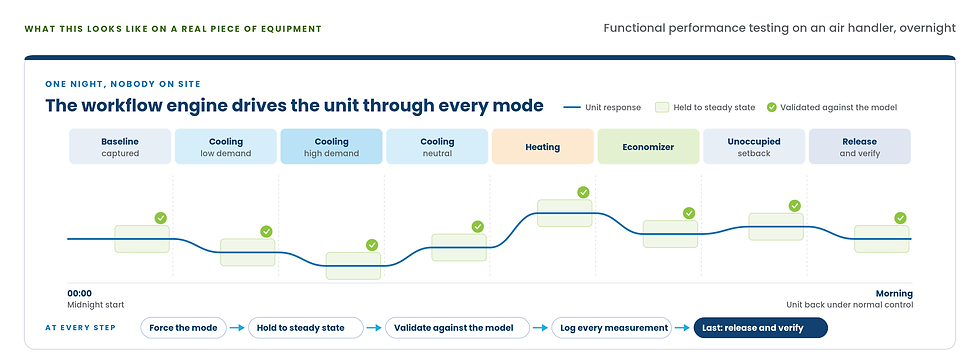
Testing an air handler properly means driving it through its modes and watching how it responds: cooling at low, high, and neutral demand, then heating, then the economizer, then unoccupied setback. Multiple control loops, airside behaviour, safety interlocks.
Done by hand, it takes hours of manual overrides with a commissioning agent on site. That is why it is almost always done on a sample of units, and almost never done again after handover.
What the workflow engine does instead
The engine runs the sequence.
It starts at midnight by capturing a baseline. It works through each mode in turn, driving setpoints, valves, and dampers, and it holds every condition to steady state before it judges anything. It validates the response against what the model says the equipment should do, and it logs every measurement as it goes.
At the end, it releases every setpoint it forced and confirms that the unit is back under normal control before it finishes.
In the morning there is a structured, documented test record. Nobody sat up watching it.
Everything the test does runs inside the same boundary as any other action in TwinWorX: the limits your engineers set, the seven writeback controls, and automatic reversion to local control if communication is lost.
Two things follow
Coverage. Tests that run overnight can cover the whole fleet across a few nights, rather than the ten or twenty percent of units a sampling agent typically reaches.
Habit. The same test that runs once at commissioning can be scheduled monthly, seasonally, or after a repair. Functional testing stops being an event at handover and becomes something the building does to itself, continuously.

What it does not replace
This does not remove the commissioning agent. It removes the part of their job that involves being on site at two in the morning for the fifth night running.
Defining what the test should prove, and judging what the results mean, is still engineering judgement, and it is still theirs.
Where this sits in the three stages
Running a test like this means the platform is writing to equipment, so it belongs to Stage 3, and it climbs the same autonomy ladder as everything else. Most teams start by running it with an engineer approving the start of each test, and move it up only when they have seen enough clean records to trust it.
Tell us which equipment you have never had time to test properly.
Thirty minutes with one of our engineers.
